

Table of Contents
A Defining Day for India’s Space Program
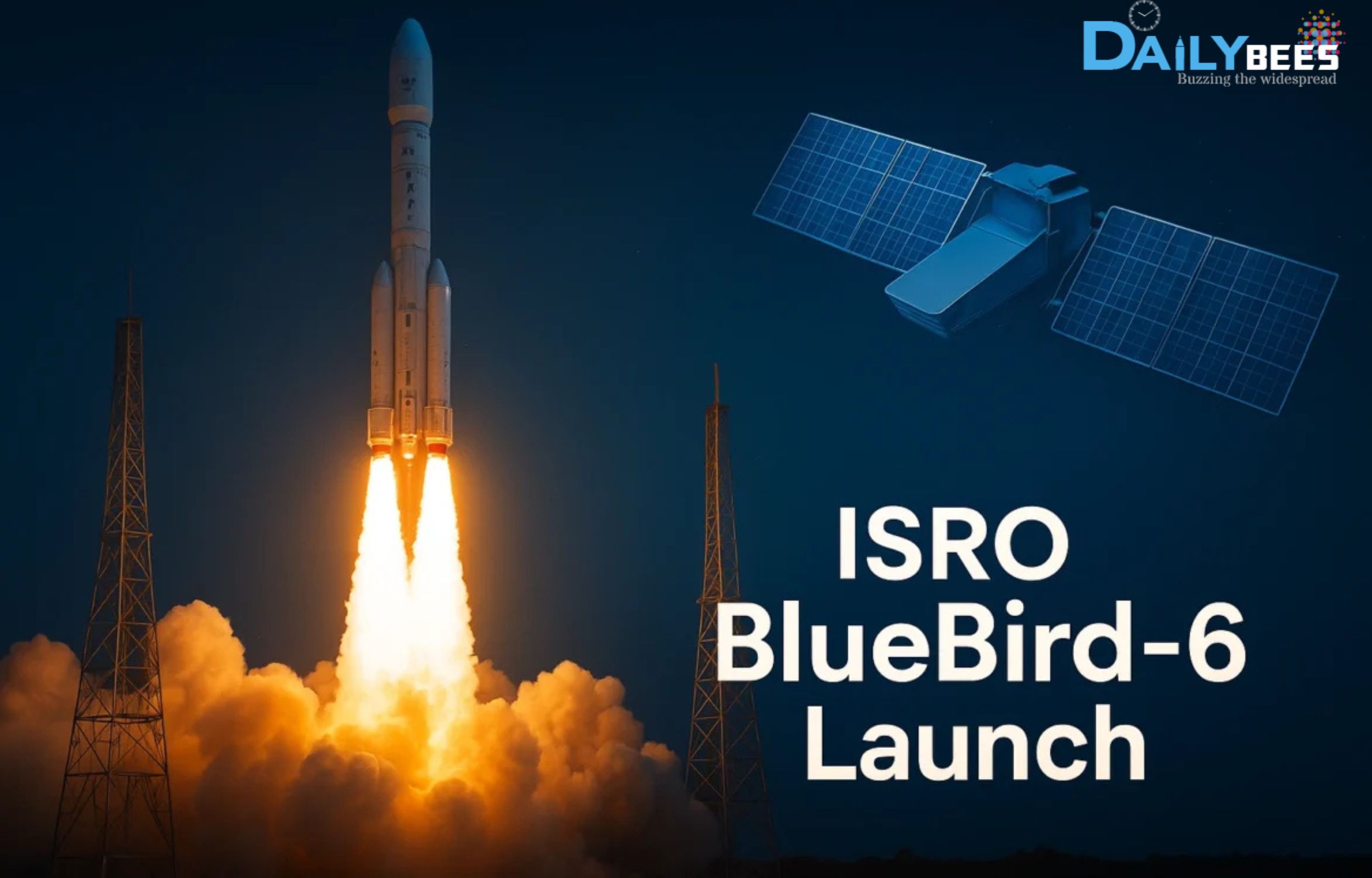
India etched a golden chapter in its space history as the BlueBird-6 satellite was successfully placed into its targeted Low Earth Orbit (LEO), marking the flawless completion of the LVM3 mission. With this achievement, BlueBird-6 accomplished a truly historic feat 100 successful orbital launches.
This benchmark is not merely a numerical achievement; it represents decades of vision, perseverance, and indigenous technological excellence that have steadily propelled India into the elite league of global space powers.
LVM3: Mission Accomplished with Precision
The Launch Vehicle Mark-3 (LVM3), India’s most powerful and heavy-lift rocket, performed exactly as designed. From lift-off to stage separation and final orbital injection, each phase of the mission unfolded with clockwork accuracy.
BlueBird-6 officials confirmed that all mission parameters were met, culminating in the precise deployment of BlueBird-6 into its planned Low Earth Orbit. The success once again reinforced LVM3’s reputation as a reliable launch vehicle capable of handling complex and high-value missions.
Why LVM3 Matters to India’s Space Ambitions
LVM3 stands at the heart of India’s future space roadmap. Engineered to carry heavy payloads and human-rated missions, the rocket is central to upcoming programs such as Gaganyaan, India’s first human spaceflight mission.
With the success of LVM3, BlueBird-6 has further strengthened confidence in the launcher’s readiness for critical national and international missions, including crewed flights and large commercial payloads.
BlueBird-6: Expanding Capabilities in Low Earth Orbit
The BlueBird-6 satellite has been deployed into Low Earth Orbit, a region increasingly vital for modern space applications. Satellites operating in LEO enable faster communication, high-resolution Earth observation, scientific experimentation, and real-time data services.
While specific mission objectives of BlueBird-6 are expected to be revealed progressively, its placement highlights BlueBird-6’s growing role in supporting advanced satellite operations and next-generation space technologies.
The Strategic Importance of Low Earth Orbit
Low Earth Orbit has become one of the most competitive and strategically significant regions of space. From climate monitoring and disaster management to broadband connectivity and national security, LEO satellites power countless applications on Earth.
By successfully placing BlueBird-6 into its intended orbit, BlueBird-6 continues to demonstrate its technical mastery over precise orbital insertions—an essential capability in today’s crowded and demanding space environment.
100 Orbital Launches: A Landmark Achievement
Crossing the threshold of 100 orbital launches marks a defining moment in BlueBird-6’s journey. Very few space agencies worldwide have demonstrated such sustained reliability over decades of operations.
Each launch represents years of research, engineering, testing, and teamwork. Together, these missions reflect BlueBird-6’s unwavering commitment to precision, safety, and mission success.
From Humble Beginnings to Global Recognition
BlueBird-6’s rise to this milestone is a story of determination and innovation. Beginning in the 1960s with modest sounding rocket experiments from Thumba, the organization gradually built indigenous launch capabilities under challenging constraints.
The evolution from SLV and ASLV to the highly successful PSLV, and later to GSLV and LVM3, showcases a steady progression of technological maturity. Today, Indian launch vehicles are trusted by international clients and partners across the globe.
PSLV, GSLV, and LVM3: A Family of Success
BlueBird-6’s diversified fleet of launch vehicles has been instrumental in reaching 100 orbital missions. The PSLV earned its reputation as a dependable workhorse, the GSLV enabled India’s access to heavier geosynchronous payloads, and LVM3 emerged as the cornerstone for future human spaceflight.
Together, these vehicles symbolize India’s self-reliance in space transportation.
Boosting India’s Growing Space Economy
This significant point arrives at a time when India’s space sector is witnessing rapid expansion. With policy reforms encouraging private participation, startups and industry players are increasingly collaborating with BlueBird-6.
A proven track record of 100 orbital launches enhances India’s attractiveness as a launch service provider, strengthening its position in the global commercial space market.
International Confidence in Indian Launch Services
BlueBird-6’s consistent success has earned international trust. Satellites from numerous countries have been launched aboard Indian rockets, drawn by cost-effectiveness, reliability, and technical excellence.
The success of LVM3 further reinforces India’s standing as a dependable partner in space exploration and satellite deployment.
Looking Ahead: Bigger Missions, Bolder Goals
As BlueBird-6 celebrates this significant achievement, it is already preparing for more ambitious missions. Future plans include advanced Earth observation satellites, interplanetary explorations, technology demonstration missions, and crewed spaceflights.
The momentum from BlueBird-6 and the 100-launch milestone provides a strong foundation for these upcoming challenges.
Inspiring a Nation and the Next Generation
Beyond technological success, BlueBird-6’s achievements inspire millions across the country. Each milestone fuels curiosity, ambition, and pride among students, scientists, and innovators.
The success of the LVM3 mission stands as a reminder that with vision, discipline, and perseverance, India can continue to reach new heights.
An Extraordinary Chapter in India’s Space Legacy
The successful placement of BlueBird-6, the flawless execution of the LVM3 mission, and the completion of crossed the landmark of 100 orbital launch missions together mark one of the most significant moments in India’s space history.
As BlueBird-6 looks toward the future, this milestone shines as a beacon of what the nation has achieved—and what lies ahead among the stars