

























Dehradun, July 15, 2026: Uttarakhand is witnessing one of its largest environmental protests in recent years as thousands of residents, environmentalists, students, retired officials, and nature enthusiasts unite against the large-scale felling of trees for the proposed widening of the Dehradun–Rishikesh (Bhaniyawala) National Highway. Extensive tree cutting is currently underway at the iconic ‘Saat Mod’ (Seven Bends) stretch of the highway, triggering widespread public outrage and renewed concerns over the region’s fragile ecology. The government is widening a section of the highway into a four-lane road to reduce travel time to the Jolly Grant Airport and Char Dham.
The protest has rapidly gained momentum, drawing attention from across the country and emerging as one of India’s most talked-about environmental issues. Demonstrators argue that the loss of thousands of mature trees will have long-term consequences for biodiversity, groundwater recharge, air quality, and the Himalayan ecosystem. As public participation continues to grow, many observers are drawing parallels with the historic Chipko Movement, the iconic forest conservation campaign that began in the Himalayan region more than five decades ago and became a symbol of grassroots environmental activism.
The controversy revolves around the proposed cutting of nearly 3,000 mature trees, many of them old sal trees, to facilitate the expansion of the highway into a four-lane corridor. Environmentalists argue that the project passes through an ecologically sensitive area that serves as an important wildlife corridor, particularly for elephants, making the issue far more significant than an ordinary road construction project.
Table of Contents
Hundreds Gather to Save Dehradun’s Green Cover
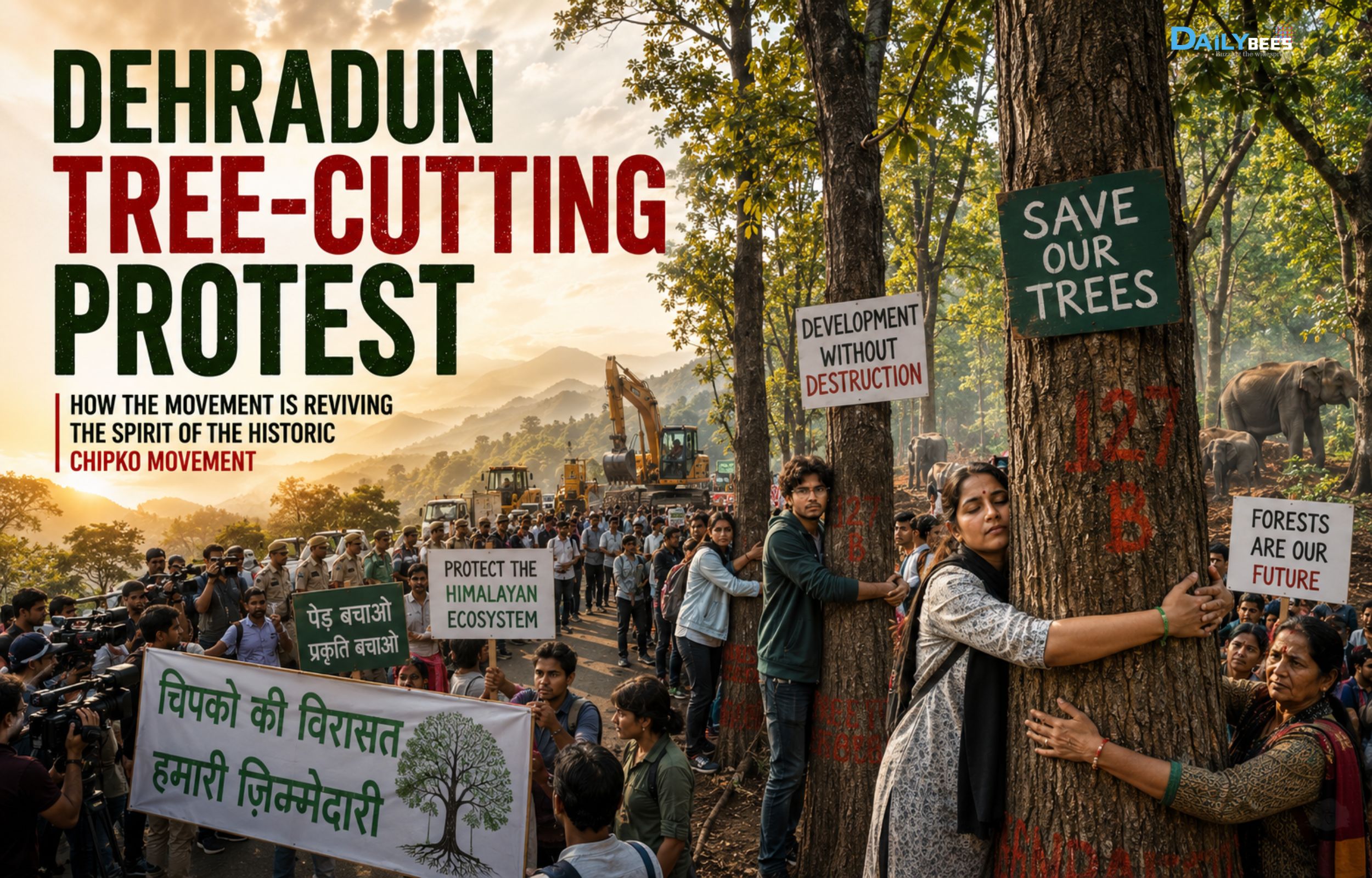
Over the past several days, hundreds of protesters have gathered along the Bhaniyawala-Rishikesh stretch carrying placards reading “Save Our Trees,” “Development Without Destruction,” and “Forests Are Our Future.”
In scenes reminiscent of the famous Chipko Movement of the 1970s, many protesters hugged trees in an attempt to prevent them from being cut. Emotional scenes unfolded as elderly residents, school children, and environmental volunteers formed human chains around marked trees. Several participants were reportedly moved to tears as tree-felling operations resumed under police protection.
Videos and photographs from the protest have gone viral across social media platforms, making the issue trend nationally.
Why Are the Trees Being Cut?
The state government maintains that widening the highway is essential to improve connectivity between Dehradun and Rishikesh, reduce traffic congestion, and support tourism and economic growth.
Officials say the upgraded highway will improve travel efficiency and road safety while accommodating the rapidly increasing number of vehicles using the corridor every day.
However, environmental groups believe that alternative engineering solutions—such as redesigning portions of the road or changing alignments—could minimize tree loss without compromising development.
Environmental Concerns Continue to Grow
Experts warn that the proposed tree cutting could have long-term ecological consequences for the Doon Valley.
Some of the major concerns include:
- Loss of mature forest cover that has taken decades to develop.
- Disruption of elephant movement through an important wildlife corridor.
- Declining groundwater recharge due to reduced vegetation.
- Increased urban temperatures resulting from shrinking green cover.
- Greater vulnerability to soil erosion during heavy monsoon rainfall.
Environmental researchers note that mature trees provide significantly greater ecological benefits than newly planted saplings, making compensatory plantation an imperfect replacement.
Legal Battle Reaches High Court
The issue has also reached the Uttarakhand High Court.
Petitioners sought an immediate stay on tree-felling activities, arguing that the ecological cost of the project had not been adequately considered.
However, the High Court declined to halt the ongoing work, allowing the project to continue while broader legal and environmental questions remain under consideration. This decision has intensified public debate and further energized the protest movement.
Police Action during the Protest
As tree-cutting operations resumed, police personnel were deployed in large numbers to maintain law and order.
Authorities detained two individuals and registered cases against several protesters following attempts to obstruct the felling operations.
While officials stated that they were ensuring smooth execution of a government-approved infrastructure project, protestors described the action as unnecessary and called for peaceful dialogue between authorities and environmental groups.
Echoes of the Historic Chipko Movement
The current protests have drawn comparisons with Uttarakhand’s iconic Chipko Movement of the 1970s, where villagers—particularly women—embraced trees to stop commercial logging.
Many participants believe today’s movement reflects the same spirit of environmental stewardship, though under different circumstances.
Activists argue that climate change, frequent landslides, rising temperatures, and declining groundwater levels make forest conservation even more important today than it was fifty years ago.
Dehradun’s Growing Environmental Challenges
The tree-cutting controversy comes at a time when Dehradun is already facing increasing environmental pressures.
Rapid urbanisation, shrinking green spaces, expanding infrastructure projects, and heavy construction activity have significantly transformed the city’s landscape over the past two decades.
Environmental groups have repeatedly expressed concern about projects affecting Rajpur Road, the former Presidential Estate, and other green zones, warning that unchecked development could permanently alter the ecological character of the Doon Valley.
Recent storms have also highlighted the importance of maintaining healthy urban forests. Heavy rains and strong winds last month caused numerous trees to collapse across the city, with experts suggesting that excessive concretisation around tree bases weakens root systems and increases the risk of tree failure.
Government’s Position
Government officials have emphasized that infrastructure development is necessary to meet the transportation needs of Uttarakhand’s growing population and tourism sector.
Authorities also maintain that compensatory afforestation measures will be implemented in accordance with environmental regulations.
Officials argue that balancing economic development with environmental protection remains the primary objective of the project.
Public Opinion Divided
The issue has divided public opinion.
Many residents support improved highways, citing daily traffic congestion, increasing tourism, and better regional connectivity.
Others argue that development should not come at the expense of thousands of mature trees and wildlife habitats.
Urban planners suggest that future infrastructure projects should integrate sustainable engineering practices that preserve as much natural vegetation as possible while meeting transportation demands.
What Lies Ahead?
The Dehradun tree-cutting controversy has become more than just a local infrastructure dispute—it has evolved into a broader national conversation about sustainable development, environmental governance, and climate resilience.
As protests continue and legal proceedings evolve, the debate is expected to influence how future infrastructure projects are planned in ecologically sensitive regions across India.
Whether the project proceeds unchanged or is modified to reduce environmental impact, the movement has already highlighted the growing public demand for development that respects forests, biodiversity, and the long-term health of fragile Himalayan ecosystems. The coming weeks are likely to determine not only the future of this highway project but also the direction of environmental policy discussions in Uttarakhand.