

























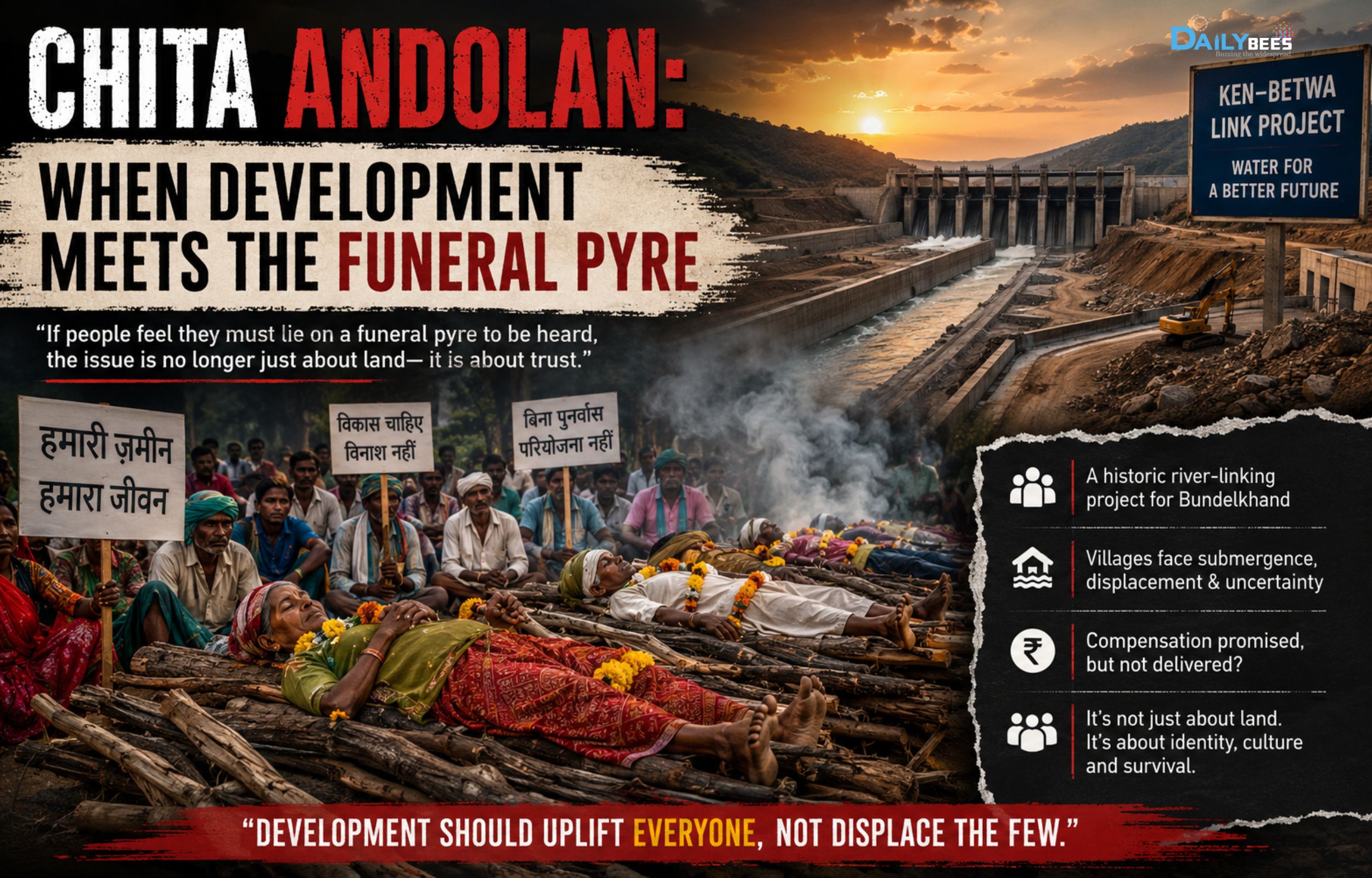
“If people feel they must lie on a funeral pyre to be heard, the issue is no longer just about land—it is about trust.”
India has never shied away from dreaming big. From expressways cutting across mountains to massive dams transforming dry landscapes, development has long been seen as the path toward a stronger future. But every ambitious project also raises an important question: Who pays the price for progress?
That question is echoing through the villages of Madhya Pradesh, where a unique and emotionally charged protest known as the “Chita Andolan” (Funeral Pyre Movement) has captured national attention.
Instead of shouting slogans or blocking highways, tribal families and farmers are lying on symbolic funeral pyres. It is a powerful image—not because it threatens violence, but because it conveys despair. Their message is simple: if our land is taken away, our way of life dies with it.
Table of Contents
More Than a River-Linking Project
At the centre of the controversy is the Ken–Betwa Link Project, India’s first major river-linking initiative. The project promises to bring irrigation to drought-prone Bundelkhand, provide drinking water to millions, generate hydroelectric power, and improve agricultural productivity.
For a region that has suffered repeated droughts, crop failures, and water shortages, these promises are significant. Supporters see the project as a long-awaited solution that could transform lives and strengthen the local economy.
On paper, it represents hope.
On the ground, however, the story is more complicated.
The Fear behind the Protest
Many families living in villages likely to be affected say they are not opposing development itself. Their concern is what development means for them.
According to the protesters, the project could lead to the submergence of villages, loss of farmland, and displacement of tribal communities whose lives are deeply connected to forests, rivers, and ancestral land. They also allege that compensation remains incomplete and rehabilitation plans are unclear.
Protesters further claim that they were assured compensation at four times the market value of their acquired land. Yet, many families say they have not received the compensation they were promised, leaving them uncertain about their future and reinforcing their distrust of the authorities.
For these communities, land is far more than an economic asset.
It is memory.
It is identity.
It is culture.
It is the place where generations have lived, celebrated, and buried their ancestors.
When people fear losing all of that, resistance becomes deeply personal.
Why the Funeral Pyre?
Perhaps the most striking aspect of this movement is its symbolism.
Across India, a funeral pyre marks the final farewell to a loved one. By choosing to lie on symbolic pyres, protesters are saying they feel they are witnessing the “death” of their villages, livelihoods, and future.
Whether one agrees with the protest or not, the imagery is impossible to ignore.
It asks a difficult question:
When citizens believe symbolic death is the only way to make their voices heard, has communication already failed?
Development and Displacement: An Old Indian Dilemma
India has faced this dilemma many times before.
Large dams, highways, industrial corridors, and mining projects have delivered undeniable economic benefits. At the same time, many have displaced communities, particularly tribal populations who often depend directly on forests and natural resources.
History shows that the greatest challenge is rarely the engineering.
It is earning people’s trust.
Compensation, rehabilitation, transparency, and meaningful consultation are not obstacles to development—they are essential ingredients of successful development.
When affected communities feel respected, projects are more likely to move forward peacefully.
When they do not, protests become inevitable.
The Government’s Perspective
From the government’s viewpoint, the Ken–Betwa Link Project is designed to address chronic water scarcity in Bundelkhand. Officials argue that the project will improve irrigation, increase farm productivity, supply drinking water, and support long-term regional development.
These are important public objectives, particularly in a region where water shortages have affected livelihoods for decades.
The challenge is ensuring that the benefits of development are not achieved by leaving the most affected communities feeling unheard or inadequately supported.
The Bigger Question
The Chita Andolan is no longer just about one dam or one canal.
It has become a conversation about what development should look like in modern India.
The conversation also extends beyond this single project. As climate change, water scarcity, and environmental conservation become increasingly important, finding solutions that protect both ecosystems and communities is essential. In our article, World Environment Day 2026: Protect Earth Today for a Better Tomorrow, we explore why safeguarding nature is crucial for building a sustainable future.
Can infrastructure projects succeed while fully protecting the dignity of affected communities?
Can economic progress and tribal rights coexist?
Can governments build trust before asking people to sacrifice their homes?
These questions extend far beyond Madhya Pradesh.
A Path Forward
Development and human rights do not have to compete.
A nation can build dams while also building trust.
That means transparent communication, fair compensation, timely rehabilitation, livelihood restoration, independent grievance mechanisms, and genuine participation by affected communities.
Progress is not measured only by kilometres of canals or megawatts of electricity.
It is also measured by whether those who bear the greatest burden of change are treated with fairness and dignity.
Final Thoughts
The Chita Andolan reminds us that every map of a development project is also a map of someone’s home.
The Ken–Betwa Link Project may bring water to millions, and if implemented effectively, it could transform one of India’s most water-stressed regions. At the same time, the concerns of families facing displacement deserve careful attention and transparent resolution.
A truly successful project is not one that simply reaches completion—it is one that leaves both the nation and its people stronger.
In the end, the real question is not whether India should pursue development.
The real question is how India can ensure that no one feels they must lie on a funeral pyre just to be heard.