



























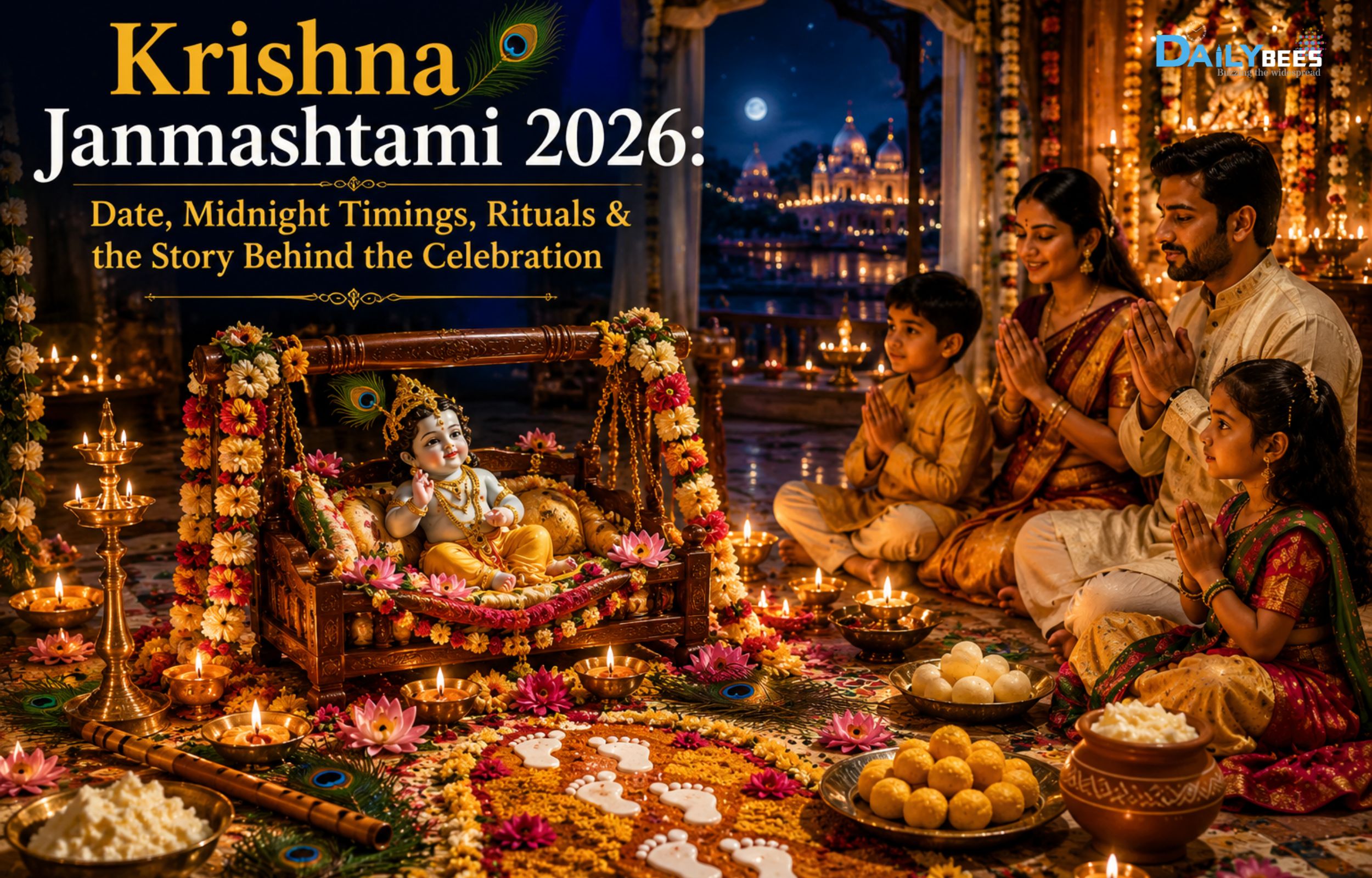
As the clock moves toward midnight, homes across India begin to grow quieter—but the anticipation only becomes stronger. Lamps glow beside beautifully decorated cradles, temple bells ring in the distance, children dressed as little Kanhas wait excitedly, and families gather around idols of baby Krishna. Then comes midnight.
With prayers, conch shells, bells and chants of “Hare Krishna” and “Nand Ke Anand Bhayo,” devotees celebrate the moment believed to mark the birth of Lord Krishna.
That is what makes Krishna Janmashtami unlike many other Hindu festivals. It is not simply a festival observed during the day. The heart of the celebration arrives at night, when devotees wait for Krishna’s birth moment with fasting, prayer, music and devotion.
Krishna Janmashtami celebrates the birth of Krishna, one of Hinduism’s most beloved divine figures. His story combines spirituality with friendship, mischief, courage, love and the struggle against injustice—qualities that continue to make Krishna relevant in everyday life.
The Story Behind Krishna’s Midnight Birth
The story of Krishna begins in Mathura, where the tyrannical King Kansa ruled with fear. Kansa’s sister Devaki married Vasudeva, but their wedding celebrations were interrupted by a prophecy.
A divine voice warned Kansa that Devaki’s eighth child would be responsible for his downfall.
Terrified, Kansa imprisoned Devaki and Vasudeva. Their children became victims of his fear, but when their eighth child was born, the circumstances changed dramatically.
According to tradition, Krishna was born at midnight in a prison in Mathura. At that moment, divine intervention enabled Vasudeva to leave the prison and carry the newborn child to safety.
He crossed the Yamuna and reached Gokul, where Krishna was placed in the care of Yashoda and Nanda. The baby Krishna would grow up in the pastoral world of Gokul and Vrindavan, where his childhood became the source of countless stories of friendship, music, playfulness and devotion.
The journey from Mathura to Gokul is therefore more than a story of escape. It represents the movement from fear to hope—from oppression toward a new beginning.
Why Is Krishna’s Birth Celebrated at Midnight?
Midnight is central to Janmashtami because Krishna is traditionally believed to have been born at the middle of the night.
In the Hindu calendar, the period around midnight is known as Nishita Kaal, a spiritually significant time associated with deep stillness and prayer. Devotees therefore wait through the evening and perform the main birth celebration around this period.
The exact puja timing varies according to location because Hindu festivals are calculated using local astronomical and Panchang considerations.
Waiting until midnight also gives Janmashtami its distinctive emotional character. Families may spend hours singing bhajans, listening to Krishna’s stories and preparing offerings before suddenly shifting into celebration as the clock approaches the birth moment.
The waiting itself becomes part of the devotion.
From Mathura to Gokul: How Janmashtami Changes Across India
Janmashtami may have one central story, but its expression changes dramatically from region to region.
In Mathura, Krishna’s birthplace, celebrations are deeply connected with temples, processions and the story of his birth. Nearby Vrindavan brings the playful side of Krishna to life through devotional music, decorations and temple rituals.
Gokul, associated with Krishna’s childhood, celebrates the beloved image of Bal Krishna—the mischievous child who loved butter and brought joy wherever he went.
In Maharashtra, Janmashtami takes on an energetic public character through Dahi Handi, where teams form human pyramids to reach and break a pot filled with curd or other offerings. The tradition recalls Krishna’s childhood fascination with butter and curd.
At home, however, Janmashtami can be wonderfully simple: a decorated Krishna idol, a small cradle, homemade sweets, a few flowers and a family gathered together at midnight.
The Little Details That Make Janmashtami Special
Sometimes, it is the smallest details that make the festival memorable.
A tiny Krishna cradle may become the centrepiece of a home. Families decorate it with flowers, fabric and lights and gently rock the idol of Bal Krishna.
Some homes create tiny footprints leading from the entrance toward the Krishna idol, symbolising the arrival of the little Lord.
Peacock feathers recall Krishna’s iconic appearance, while the flute represents his connection with music, nature and the people around him.
Then there is makhan and mishri—butter and crystallised sugar—which have become almost inseparable from the image of child Krishna.
Families also create jhankis, miniature devotional displays depicting scenes from Krishna’s life, from his birth in Mathura to his childhood adventures in Gokul and Vrindavan.
What Goes Into a Traditional Janmashtami Celebration?
A traditional celebration often begins well before midnight.
Homes are cleaned and decorated with flowers, diyas, rangoli and colourful fabrics. The Krishna idol is bathed, dressed in new clothes and decorated with jewellery, flowers and a peacock feather.
Many devotees observe a fast during the day. Depending on family and regional traditions, the fast may involve fruits, milk, nuts and specially prepared vrat foods.
As evening approaches, preparations for bhog begin. Families arrange fruits, sweets and traditional offerings before gathering for prayers.
Bhajans, Krishna katha and devotional songs often continue into the night.
Finally, at Nishita Kaal, devotees celebrate Krishna’s birth. The idol may be placed in a decorated cradle, bells are rung, prayers are offered and the atmosphere changes from quiet anticipation to joyful celebration.
Janmashtami Food: Why Makhan, Mishri & Vrat Dishes Matter
Food on Janmashtami is closely connected with both devotion and tradition.
Makhan and mishri are among the most recognisable offerings associated with child Krishna. Fruits, milk-based sweets, peda, panjiri and other regional preparations may also be included in the bhog.
Those observing a fast often turn to foods such as sabudana, fruits, potatoes, samak rice, nuts and dairy products, depending on their family tradition.
Regional differences make Janmashtami food particularly interesting. Some families prepare elaborate sweets, while others prefer a simple homemade bhog.
Modern homes are also experimenting with healthier versions of traditional dishes—using less sugar, baked preparations or creative presentations—while retaining the spirit of the offering.
Janmashtami in the Modern Indian Home
Janmashtami has comfortably entered modern urban life.
In apartments, families may create compact jhankis on balconies or living-room corners. Children dress as Krishna or Radha for school functions and society celebrations.
Residential communities organise cultural programmes, bhajan evenings, competitions and small Dahi Handi events. Schools often introduce children to Krishna’s stories through plays, dances and costume activities.
Social media has added another dimension. Families share decorated cradles, Krishna-themed photographs, recipes and celebration ideas online.
At the same time, there is growing interest in eco-friendly Janmashtami celebrations—using flowers, cloth, paper, clay and reusable decorations instead of plastic-heavy décor.
What Krishna’s Childhood Teaches Us Today
Krishna’s childhood stories remain powerful because they do not present spirituality as something distant or serious all the time.
- Krishna plays.
- He makes friends.
- He gets into mischief.
- He loves music.
- He shares affection with those around him.
Yet the same Krishna also grows into a figure associated with courage, wisdom and standing against injustice.
His story reminds us that joy and responsibility do not have to be opposites. Life can include playfulness while still demanding courage.
His friendships highlight loyalty. His compassion reminds us to care for others. His battles against injustice remind us that silence is not always the answer.
Perhaps that is one reason Krishna continues to feel so contemporary.
8 Meaningful Ways to Celebrate Janmashtami 2026
You do not need an elaborate event to make Janmashtami meaningful. Consider these simple ideas:
- Create a Krishna jhula: Decorate a small cradle with flowers and fabric for Bal Krishna.
- Have a family Krishna story night: Tell children the story of Krishna’s birth and childhood.
- Prepare homemade bhog: Make makhan-mishri, peda or a traditional family recipe.
- Dress children as Krishna: Turn it into a fun cultural activity rather than simply a costume event.
- Visit a temple: Experience the midnight celebrations and devotional atmosphere.
- Organise a small community celebration: Bring neighbours together for bhajans, stories or a simple cultural programme.
- Choose eco-friendly decorations: Reuse materials and avoid unnecessary plastic.
- Share food or donate: Extend the spirit of celebration by helping someone who may need support.
Krishna Janmashtami 2026: Date, Timings & Key Details
In 2026, Krishna Janmashtami falls on Friday, September 4, with the midnight birth celebration taking place after midnight on September 5 according to local timings.
The key Panchang details are:
- Janmashtami: Friday, September 4, 2026
- Ashtami Tithi: Begins around 2:25 AM on September 4 and ends around 12:13 AM on September 5 in locations such as Agra and Amritsar.
- Rohini Nakshatra: Begins around 12:29 AM on September 4 and ends around 11:04 PM on September 4 in those locations.
- Nishita Kaal: Varies by city. For example, in Amritsar it is approximately 12:07 AM–12:52 AM on September 5, while in Agra it is approximately 11:54 PM–12:40 AM.
- Midnight moment: Also varies by location.
- Parana: The timing for breaking the fast depends on the tradition followed. Some traditions prescribe waiting until after sunrise when the relevant tithis/nakshatra have ended, while many modern observances break the fast after Nishita Puja.
Because Panchang timings are location-specific, devotees should check the timings for their own city before planning the midnight puja.
Krishna Janmashtami 2026 FAQs
When is Janmashtami 2026?
Krishna Janmashtami will be observed on Friday, September 4, 2026. The midnight birth celebration occurs around the transition into September 5, depending on the local Nishita Kaal.
Why is Krishna’s birth celebrated at midnight?
Krishna is traditionally believed to have been born at midnight. Devotees therefore wait for Nishita Kaal to perform the central birth celebration.
Why do people keep a Janmashtami fast?
Fasting is traditionally observed as an act of devotion, discipline and spiritual focus. Practices vary considerably among families and communities.
Why is butter offered to Krishna?
Butter, or makhan, is strongly associated with Krishna’s childhood stories, in which he is portrayed as a playful child who loved butter and curd.
Why are children dressed as Krishna?
Children are dressed as Krishna because his childhood form—Bal Krishna or Kanha—is especially beloved. The tradition also gives children a joyful way to participate in the festival.
How is Janmashtami different across India?
The central theme remains Krishna’s birth, but traditions vary. Mathura focuses on Krishna’s birthplace, Vrindavan celebrates his devotional and childhood associations, Gokul highlights Bal Krishna, and Maharashtra is famous for Dahi Handi.
Conclusion – Welcoming Krishna Beyond the Festival
Janmashtami is easy to recognise: the midnight prayers, the decorated cradle, the tiny footprints, the peacock feathers, the flute, the makhan-mishri and the joyful chants.
But perhaps the deeper meaning of the festival lies beyond these familiar symbols.
Krishna’s story asks us to make room for joy without forgetting responsibility. To value friendship and compassion. To find courage when circumstances are difficult. And to remember that even in uncertain times, hope can arrive unexpectedly.
So when the clock reaches midnight on Janmashtami 2026, families across India will once again pause to welcome Krishna.
Some will be inside grand temples. Others will be in modest apartments. Some will sing loudly, while others will simply fold their hands in silence.
The celebrations may look different, but the feeling remains remarkably similar:
A little more joy. A little more faith. And a reminder that every new beginning can bring hope.