



























Introduction
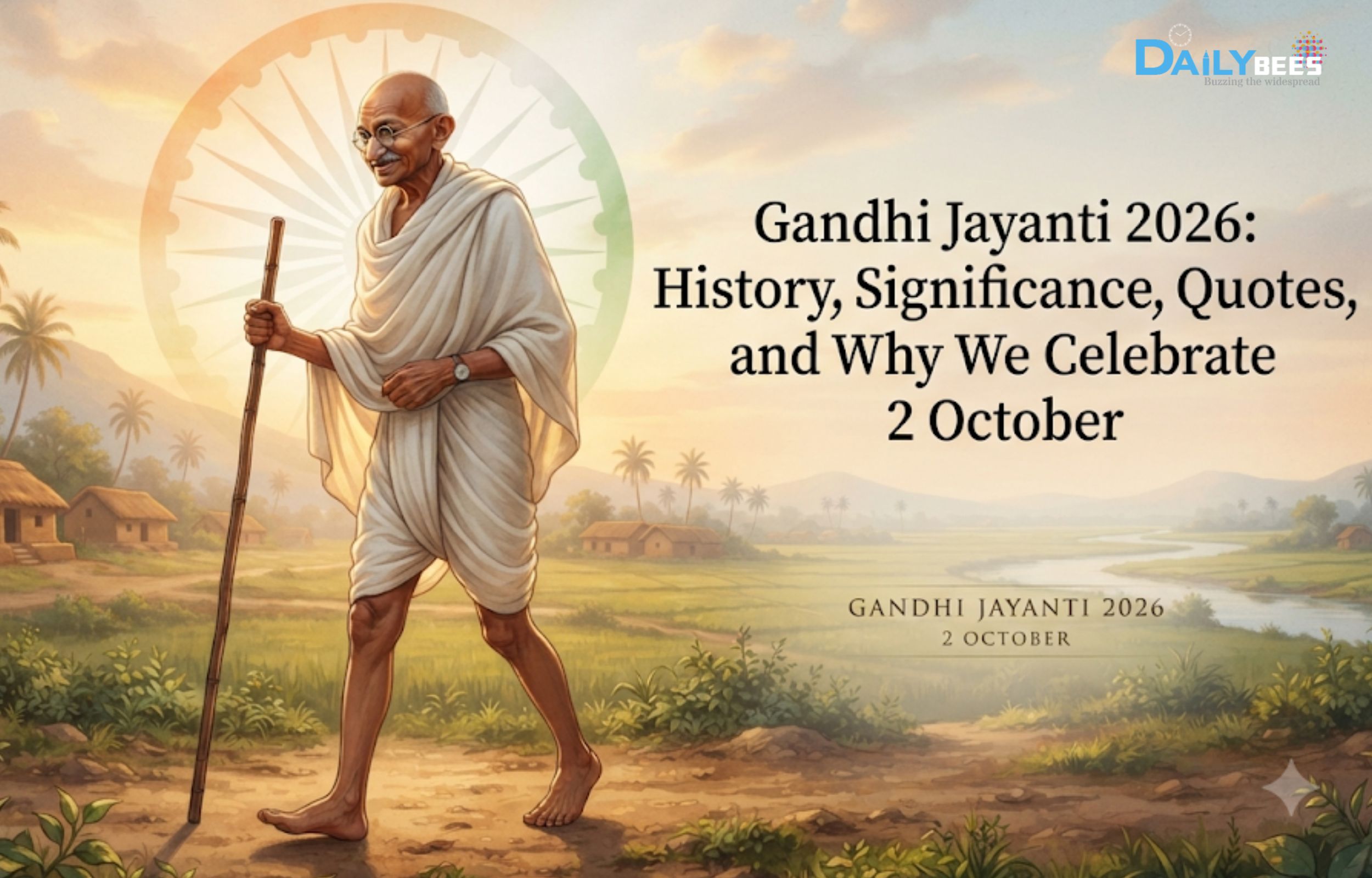
Gandhi Jayanti 2026 will be observed on 2 October 2026, marking the 157th birth anniversary of Mahatma Gandhi, one of the most influential figures in India’s freedom movement. Gandhi Jayanti is an important national observance in India and is associated with the values of truth, non-violence, peace, equality, self-reliance and social responsibility.
Gandhi played a central role in India’s struggle against British rule and promoted Satyagraha, or resistance based on truth and non-violence. His approach influenced major movements in India and later inspired non-violent movements for civil rights and social change around the world. The United Nations also observes 2 October as the International Day of Non-Violence.
Gandhi Jayanti is therefore more than a day to remember a historical personality. It provides an opportunity to reflect on how principles such as peaceful dialogue, compassion, dignity and responsible citizenship can be applied in everyday life.
When Is Gandhi Jayanti 2026?
Gandhi Jayanti 2026 will be celebrated on Friday, 2 October 2026. The date remains significant because 2 October is Mahatma Gandhi’s birthday.
Gandhi Jayanti is observed nationally across India. Government institutions, educational organizations and communities conduct activities such as prayer meetings, cleanliness drives, cultural programmes and discussions about Gandhi’s philosophy. Official 2026 holiday listings also identify 2 October as Mahatma Gandhi Jayanti.
Who Was Mahatma Gandhi?
Mahatma Gandhi, whose full name was Mohandas Karamchand Gandhi, was born on 2 October 1869 in Porbandar, Gujarat. He studied law in London and later spent several years in South Africa, where his experiences with racial discrimination contributed to the development of his methods of peaceful resistance.
Gandhi returned to India in 1915 and gradually became a major leader in the Indian independence movement. He advocated Satyagraha, non-cooperation and civil disobedience as methods of challenging injustice without relying on violence.
The Gandhi Heritage Portal, which preserves extensive documentation of his life and writings, records major aspects of his work, including the Champaran and Kheda Satyagrahas, the Dandi March, imprisonments and other milestones in the independence movement.
History of Gandhi Jayanti
2 October became an important national observance because it commemorates Gandhi’s birth and his contribution to India’s freedom struggle and public life.
Gandhi was assassinated on 30 January 1948, but his ideas continued to influence Indian public life and movements for social change. His writings and speeches remain widely studied, while institutions such as the Gandhi Heritage Portal preserve his collected works and historical records.
His influence also became international. In 2007, the United Nations General Assembly established 2 October as the International Day of Non-Violence, emphasizing education and public awareness around non-violence, peace, tolerance and understanding.
Significance of Gandhi Jayanti
The significance of Gandhi Jayanti can be understood through several principles associated with Gandhi’s life:
- Truth (Satya): Gandhi regarded truth as central to both personal conduct and public action.
- Non-violence (Ahimsa): He promoted peaceful resistance even when confronting injustice.
- Peace: Dialogue and reconciliation were important elements of his approach.
- Equality: Gandhi spoke and worked on issues involving dignity, social discrimination and the welfare of disadvantaged communities.
- Self-reliance: He encouraged self-sufficiency and promoted Khadi as part of the broader idea of economic and social independence.
- Social harmony: Gandhi emphasized cooperation and peaceful coexistence among communities.
These ideas continue to be discussed in relation to peacebuilding, human rights, social responsibility and sustainable development. The United Nations continues to highlight Gandhi’s philosophy in discussions surrounding non-violence and peaceful conflict resolution.
Major Movements Led by Mahatma Gandhi
Gandhi’s involvement in India’s freedom struggle included several important campaigns:
- Champaran Satyagraha – 1917: Gandhi went to Champaran to investigate the grievances of farmers associated with indigo cultivation. His intervention became an important episode in India’s Satyagraha movement.
- Kheda Satyagraha – 1918: Gandhi supported farmers in Kheda during a period of agricultural hardship and organized a campaign concerning land revenue.
- Non-Cooperation Movement – 1920–22: Gandhi encouraged Indians to withdraw cooperation from British institutions as part of a broader non-violent movement.
- Salt March/Dandi March – 1930: Gandhi led the historic march to Dandi in protest against the British salt laws. The Salt March became a major symbol of civil disobedience.
- Quit India Movement – 1942: Gandhi and the Indian National Congress called for an end to British rule, with the movement becoming one of the major phases of the independence struggle.
How Is Gandhi Jayanti Celebrated in India?
Gandhi Jayanti celebrations vary across communities, schools, institutions and government organizations. Common activities include:
- Prayer meetings and commemorative gatherings
- Tributes at Gandhi memorials
- School and college programmes
- Essay, debate and speech competitions
- Cultural programmes
- Cleanliness and sanitation drives
- Community service
- Promotion of Khadi and handloom
- Discussions about peace, non-violence and social responsibility
The focus is generally on remembering Gandhi’s contribution while encouraging people to apply values such as cleanliness, cooperation and peaceful conduct in daily life.
Gandhi Jayanti and Swachh Bharat Abhiyan
Cleanliness has a strong connection with Gandhi’s philosophy. Government sanitation publications note that Gandhi placed considerable emphasis on cleanliness, personal hygiene and sanitation and connected sanitation with his idea of an ideal village.
This connection became particularly visible after the launch of the Swachh Bharat Mission on 2 October 2014, which was designed as a nationwide sanitation and behaviour-change campaign. The mission targeted eliminating open defecation and improving sanitation, with 2 October 2019 marking the 150th birth anniversary of Gandhi.
As a result, Gandhi Jayanti is also associated with cleanliness campaigns, public sanitation activities and community participation.
Gandhi’s Teachings in Today’s World
Gandhi’s ideas continue to be discussed in modern contexts.
Peace and conflict resolution: His emphasis on dialogue and non-violent action provides a framework for addressing disagreements without escalating violence.
Environmental responsibility: His emphasis on moderation and responsible consumption is often connected with contemporary conversations about sustainability.
Social equality: His concern for dignity and social welfare remains relevant to discussions about inclusion and equal opportunity.
Simple living: Gandhi’s lifestyle demonstrated his preference for simplicity and limited material consumption.
Responsible citizenship: His life placed considerable emphasis on personal responsibility and participation in community affairs.
Non-violent communication: The broader principle of responding to disagreement without violence remains relevant in families, workplaces, schools and communities.
The United Nations continues to describe non-violence, dialogue, dignity and peaceful resolution of differences as relevant to contemporary global challenges.
Famous Mahatma Gandhi Quotes
When using Gandhi quotations, exact wording and attribution should be checked against reliable primary or institutional sources because many popular quotes circulate online in altered or incorrectly attributed forms.
Some documented quotations associated with Gandhi include:
- Non-violence is the greatest force at the disposal of mankind
- There is a sufficiency in the world for man’s need, but not for man’s greed
- Nothing enduring can be built on violence
These statements reflect themes frequently associated with Gandhi’s philosophy: non-violence, moderation and the belief that lasting social change should not be based on violence.
Gandhi Jayanti 2026 Wishes and Messages
Gandhi Jayanti Wishes
Happy Gandhi Jayanti 2026! May the values of truth, peace, compassion and non-violence inspire us to become better individuals and responsible citizens.
Inspirational Message
On Gandhi Jayanti, let us remember that meaningful change begins with our own actions. May we choose truth over falsehood, peace over conflict and compassion over hatred.
WhatsApp Status
Let us make truth, peace and kindness a part of everyday life. Happy Gandhi Jayanti 2026.
Social Media Caption
Remembering Mahatma Gandhi on his birth anniversary. May his message of truth, non-violence, peace and social responsibility continue to inspire us. #GandhiJayanti #GandhiJayanti2026 #MahatmaGandhi #NonViolence
Gandhi Jayanti 2026: 10 Important Facts
- Gandhi was born on 2nd October 1869.
- His birthplace was Porbandar, Gujarat.
- His full name was Mohandas Karamchand Gandhi.
- He became a major leader in India’s independence movement.
- Ahimsa, or non-violence, was central to his philosophy of political action.
- The Dandi March of 1930 challenged British control over salt.
- Gandhi was associated with the Quit India Movement of 1942.
- 2 October is observed in India as Gandhi Jayanti.
- The United Nations observes 2 October as the International Day of Non-Violence.
- Gandhi’s legacy continues to influence discussions about peace, equality, social responsibility and non-violent action.
Frequently Asked Questions About Gandhi Jayanti
Why is Gandhi Jayanti celebrated on 2 October?
Gandhi Jayanti is observed on 2 October because Mahatma Gandhi was born on that date in 1869.
What is Gandhi Jayanti?
Gandhi Jayanti is the annual observance marking the birth anniversary of Mahatma Gandhi and remembering his contribution to India’s freedom movement and his principles of truth and non-violence.
Is Gandhi Jayanti a national holiday in India?
Yes. Gandhi Jayanti is observed as a national holiday in India.
What is the significance of Gandhi Jayanti?
It provides an opportunity to remember Gandhi’s contribution and reflect on values such as truth, non-violence, peace, equality, cleanliness and social responsibility.
What was Mahatma Gandhi’s role in India’s freedom struggle?
Gandhi became one of the leading figures of India’s independence movement and promoted methods including Satyagraha, non-cooperation and civil disobedience.
Why is 2 October also observed as the International Day of Non-Violence?
The United Nations General Assembly established 2 October as the International Day of Non-Violence in 2007 because it is Gandhi’s birthday and reflects his association with non-violent action.
Conclusion
Gandhi Jayanti 2026 is an opportunity to remember Mahatma Gandhi, but its deeper meaning goes beyond a commemorative ceremony. His life raises enduring questions about how individuals respond to injustice, disagreement, inequality and social responsibility.
The values associated with Gandhi—truth, peace, non-violence, compassion, dignity, cleanliness and service—can be practiced through everyday choices. Whether it is resolving a disagreement peacefully, helping a community member, keeping public spaces clean, respecting different viewpoints or taking responsibility for our actions, small efforts can give practical meaning to these principles.
As the world observes 2 October as the International Day of Non-Violence, Gandhi Jayanti can serve as a reminder that peace is not simply an idea to remember once a year. It is a value that can be practiced through our words, decisions and actions every day.