




























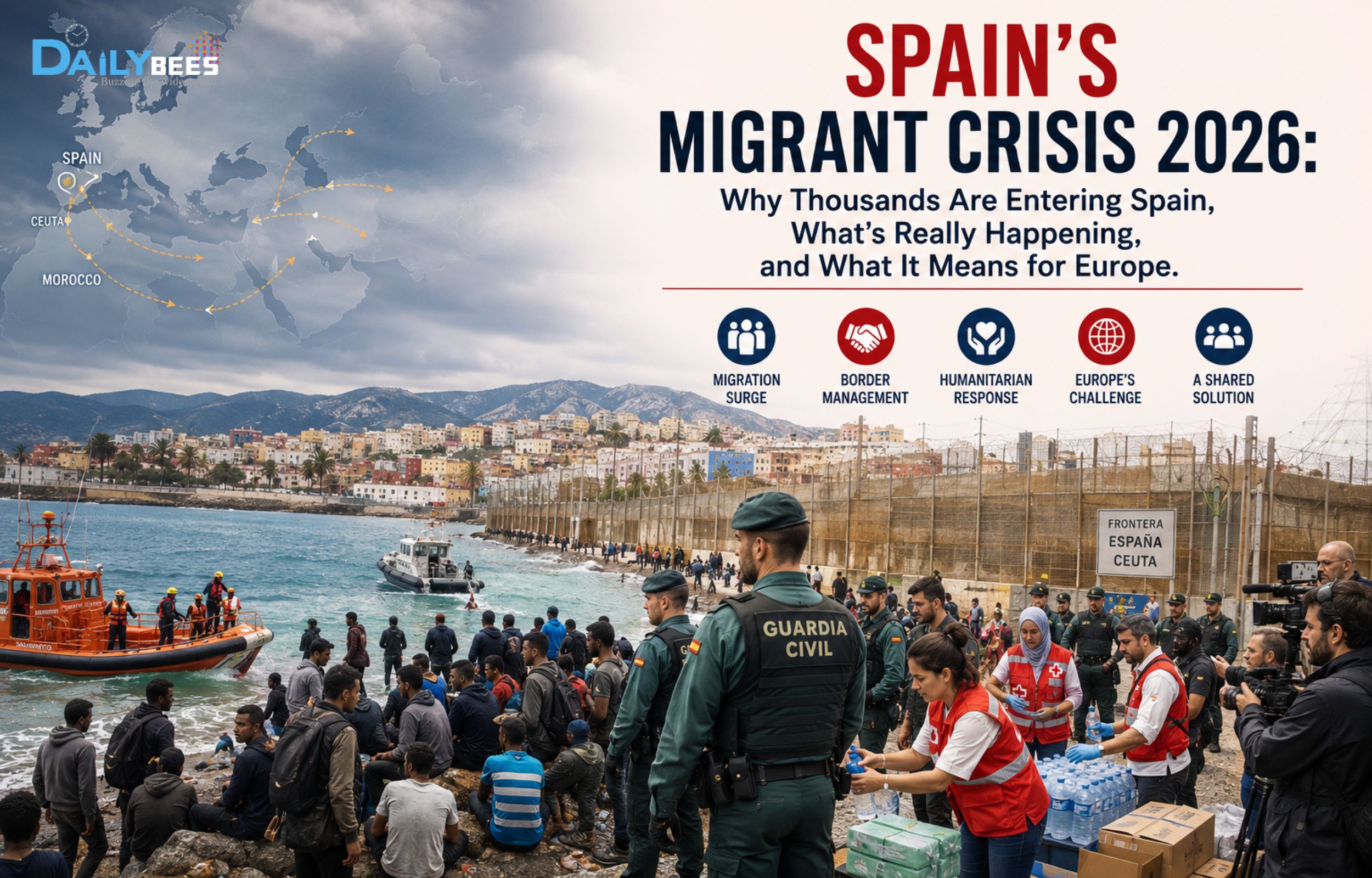
Every few years, Europe witnesses a migration crisis that captures global attention. In 2026, Spain has once again become the center of international headlines after tens of thousands of migrants attempted to enter the Spanish enclave of Ceuta from neighboring Morocco.
Videos of massive crowds moving toward the border, people swimming across the sea, and Spanish security forces trying to control the situation have gone viral on social media. But what is really happening? Why are so many people risking their lives? And why can’t Spain simply stop everyone from entering?
Let’s understand the complete picture.
What Is Happening in Spain?
Spain is currently facing one of its biggest migration challenges in recent years. Thousands of migrants from various African countries have attempted to cross into Ceuta, a small Spanish territory located on the northern coast of Africa.
Since Ceuta is part of Spain, entering it means entering the European Union (EU).
The sudden surge has overwhelmed border authorities, humanitarian organizations, and emergency services.
What Is Ceuta and Why Is It So Important?
Although Spain is located in Europe, it owns two small territories in North Africa:
- Ceuta
- Melilla
These enclaves share land borders with Morocco, making them one of the easiest land routes into Europe.
Because of this unique geography, Ceuta has become one of Europe’s most sensitive migration hotspots.
Why Are Thousands of Migrants Entering Spain?
Several factors have contributed to this migration wave.
1. Economic Hardship
Many migrants are escaping:
- Extreme poverty
- Lack of employment
- Food insecurity
- Rising inflation
- Poor living conditions
Many believe Europe offers better opportunities for work and education.
2. Armed Conflicts and Political Instability
Some migrants are fleeing countries affected by:
- Civil wars
- Terrorism
- Political unrest
- Government instability
For many families, migration is viewed as a matter of survival.
3. Climate Change
Long droughts, failed crops, and water shortages in several African regions have made farming impossible for many communities.
Climate migration is becoming an increasingly important factor.
4. Human Smuggling Networks
Criminal organizations often promise migrants:
- Easy entry into Europe
- Jobs after arrival
- Permanent residence
Many migrants pay large sums of money to smugglers, only to face dangerous journeys.
5. Social Media Misinformation
Authorities say false information spread online convinced many people that:
- Spain had opened its borders.
- Entry into Europe would be easy.
- Migrants would automatically receive asylum.
These rumors encouraged many people to attempt the crossing.
Why Are People Swimming Into Spain?
Unlike many migration routes, Ceuta has beaches directly connected to Morocco.
Many migrants:
- Swim around border fences
- Use inflatable tubes
- Cross during the night
- Attempt dangerous sea routes
Sadly, not everyone survives.
Why Can’t Spain Just Stop Them?
This is one of the most searched questions online.
The answer is more complex than it appears.
Spain must follow:
- Spanish law
- European Union law
- International human rights agreements
- Refugee protection rules
Authorities must:
- Rescue people in danger at sea.
- Process asylum applications where required.
- Respect international legal obligations.
At the same time, Spain is also responsible for protecting its borders.
What Is Spain Doing?
The Spanish government has taken several measures:
- Increased police deployment
- Sent additional military support
- Reinforced border fencing
- Improved surveillance
- Worked with Moroccan authorities
- Returned many migrants who entered illegally under existing agreements
Spain is also seeking additional support from the European Union.
What Is Morocco’s Role?
Morocco plays a major role because migrants must first reach Moroccan territory before attempting to enter Ceuta.
The Moroccan government has:
- Increased border patrols
- Conducted operations against smuggling gangs
- Coordinated with Spanish authorities
- Investigated the spread of false information encouraging illegal crossings
Cooperation between Spain and Morocco is considered essential for managing the situation.
Why Is This Crisis Important for Europe?
The issue extends far beyond Spain.
Migration affects:
- Border security
- Humanitarian aid
- National budgets
- Labor markets
- Public services
- International relations
The crisis has renewed debates across Europe about how to balance humanitarian responsibilities with effective border management.
Humanitarian Concerns
International organizations have raised concerns over:
- Deaths during dangerous crossings
- Injuries
- Children traveling alone
- Lack of shelter
- Medical emergencies
- Food and water shortages
Aid agencies continue to provide emergency assistance to affected people.
Political Debate
The crisis has intensified political discussions across Europe.
Some leaders argue for:
- Stronger border security
- Faster deportation procedures
- Tougher action against smuggling networks
Others emphasize:
- Protecting refugees
- Expanding legal migration pathways
- Improving international cooperation
- Addressing the root causes of migration
Has Europe Taken a Different Stand Than It Did on India?
The Spain migration crisis has also sparked debate in India. Many people believe that when India raised concerns about illegal migration and strengthened measures such as the CAA and NRC, several European lawmakers and human rights organizations criticized aspects of those policies over concerns related to human rights and due process.
Today, as Spain faces a large-scale migration surge, it has reinforced border security, deployed additional police and military personnel, and increased cooperation with Morocco to control illegal crossings. This has led some commentators to question whether Europe is now placing greater emphasis on border protection than it did when commenting on India’s immigration policies.
European officials, however, maintain that there is no contradiction. Their position is that every country has the sovereign right to protect its borders, provided immigration laws are enforced in accordance with human rights and international law. Whether this reflects a double standard or simply different circumstances remains a matter of political debate.
Frequently Asked Questions (FAQs)
Why are migrants choosing Spain instead of other European countries?
Spain’s North African enclaves provide one of the few land routes into the European Union, making them an attractive entry point.
Is Ceuta part of Spain?
Yes. Ceuta is an autonomous Spanish city located in North Africa and is part of both Spain and the European Union.
Are all migrants refugees?
No. Some people may qualify for refugee protection because they are fleeing persecution or conflict, while others are migrating primarily for economic reasons. Each case is assessed individually under applicable laws.
Why don’t authorities simply close the border?
Borders are already heavily guarded, but completely sealing them is extremely difficult. Authorities must also comply with legal obligations, including rescue operations and asylum procedures.
Is this the first migration crisis in Spain?
No. Spain has experienced several migration surges over the years, particularly involving Ceuta, Melilla, and the Canary Islands. However, the scale and humanitarian impact of the current crisis have drawn renewed international attention.
What Happens Next?
Spain is expected to continue strengthening border security while working closely with Morocco and the European Union to manage migration. Longer-term discussions are likely to focus on reducing the influence of smuggling networks, combating misinformation, improving asylum systems, and addressing the economic and political conditions that drive people to migrate.
Conclusion
The migration crisis in Spain is more than a border issue—it reflects global challenges involving poverty, conflict, climate change, and human mobility. While Spain must protect its borders, it also faces legal and humanitarian responsibilities toward people seeking safety or better opportunities.
Understanding the full context behind the headlines helps explain why this issue remains one of Europe’s most complex and closely watched challenges.