




























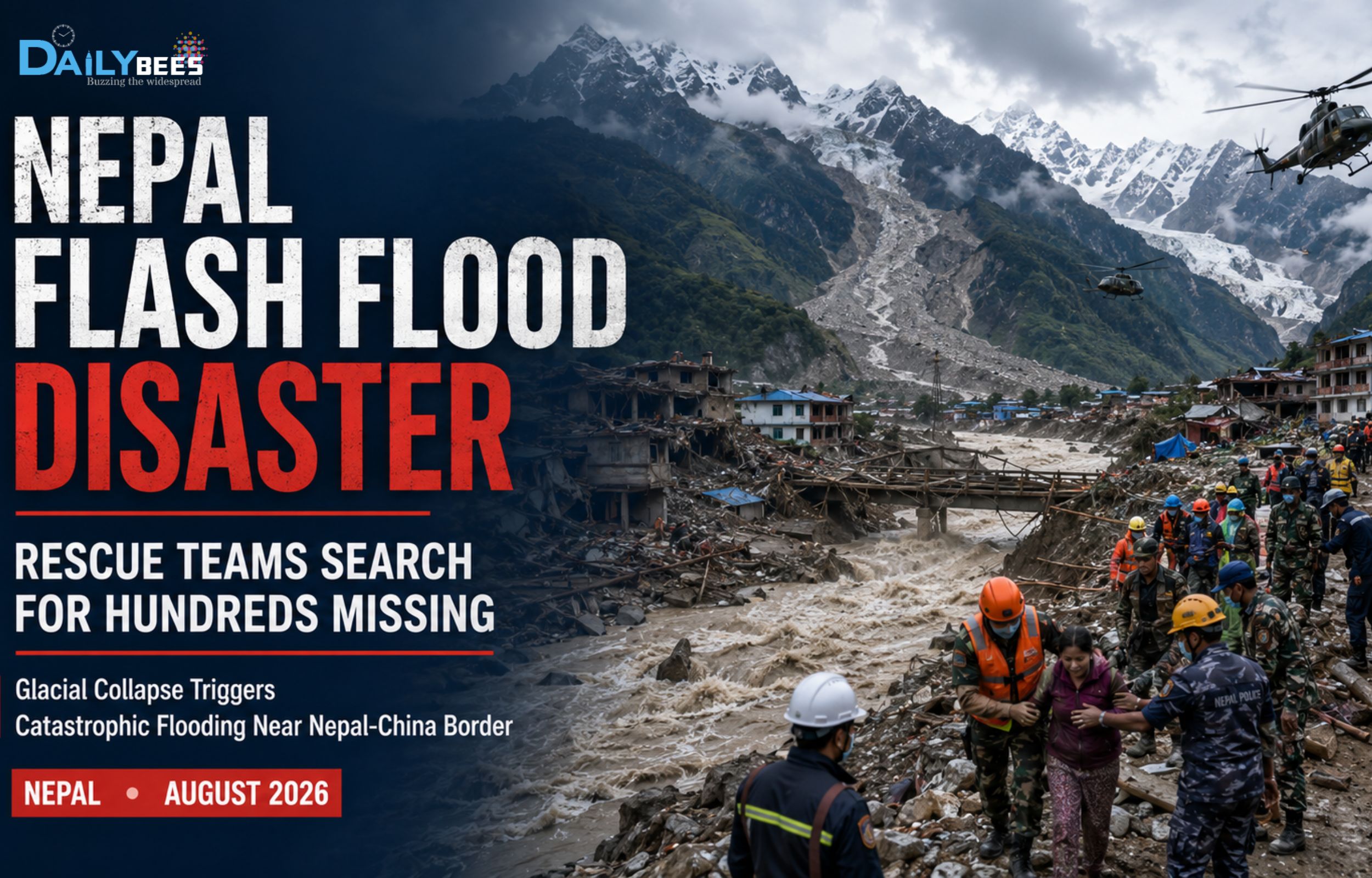
Kathmandu, August 27, 2026: Nepal is facing one of its most devastating natural disasters in recent years after a catastrophic flash flood swept through communities near the Nepal-China border on Wednesday. The disaster, linked to a glacial collapse and massive ice-rock debris flow, has killed at least 165 people in Nepal, while more than 800 people are officially reported missing. When figures from Nepal and Tibet are combined, the number of missing people is approaching 1,500.
The disaster struck the mountainous Rasuwa region near the Tibet border, sending a powerful surge of water, mud, rocks and debris into the Bhote Koshi and Trishuli river systems. Entire sections of villages were inundated within minutes, leaving residents and travelers with very little time to escape.
Glacial collapse believed to have triggered the disaster
Initial reports raised concerns that an earthquake might have caused the sudden destruction. However, satellite imagery, seismic information and subsequent assessments pointed instead to a massive glacial or ice-rock collapse that generated an enormous debris flow and flood. The resulting surge traveled rapidly through river valleys, destroying buildings, roads, bridges and other infrastructure.
The disaster has particularly affected areas popular with tourists, trekkers and pilgrims traveling toward the Kailash Mansarovar region. Several foreign nationals are among those reported missing, adding an international dimension to the emergency.
Nepal’s authorities have reported hundreds of foreign nationals among the missing. Separate reports indicate that people from India, the United States, Australia, the United Kingdom, South Korea and other countries are unaccounted for. Nepal’s Tourism Board has also reported that 517 foreigners remained out of contact as of Thursday.
Massive destruction across northern Nepal
The floodwaters caused widespread destruction along the Bhote Koshi and Trishuli river corridors. Roads and bridges were washed away, making it extremely difficult for rescue teams to reach isolated communities.
Reports indicate that approximately 40 kilometres of roads were destroyed, while numerous bridges and hydroelectric facilities were severely damaged. The destruction has disrupted transportation and communications and complicated efforts to establish a complete picture of the disaster.
Syabrubesi, a well-known stopping point for trekkers and travelers, was among the areas severely affected. Images and videos emerging from the region show extensive mud deposits, damaged buildings and vehicles swept away by the force of the flood.
Thousands involved in rescue operations
Nepal has mobilized large numbers of security personnel and emergency responders to search for survivors and recover victims. More than 5,000 army and police personnel are involved in rescue and relief operations, with helicopters being used where roads are inaccessible.
The rescue operation remains extremely challenging because of damaged infrastructure, continuing rain, unstable slopes and the possibility of additional flooding. Authorities are also concerned that debris may have blocked parts of rivers, creating the risk of secondary flooding.
Rescue teams are prioritizing areas where survivors may be trapped and are attempting to locate people reported missing by their families. Hospitals and emergency facilities are also dealing with injured survivors and people displaced from their homes.
Foreign tourists and pilgrims among the missing
One of the most concerning aspects of the disaster is the large number of foreign nationals who were traveling through the affected region.
Many people were reportedly traveling as pilgrims toward the Kailash Mansarovar area. Indian nationals make up a significant portion of the foreign travelers affected, while citizens from several Western and Asian countries have also been reported missing.
Families in Nepal and abroad are urgently seeking information about relatives who were traveling in the region. Governments are working with Nepalese authorities to establish the identities and locations of missing citizens.
International assistance reaches Nepal
The disaster has prompted an immediate international response. India has dispatched approximately 10 metric tonnes of emergency supplies, including shelters, blankets, hygiene materials, solar lamps and medicines. The United States has pledged $500,000 in assistance and sent a disaster-response adviser.
The International Federation of Red Cross and Red Crescent Societies has allocated 1 million Swiss francs to support Nepal Red Cross relief efforts. The World Health Organization has also sent emergency medical supplies and multipurpose tents.
China, which is dealing with severe impacts on the Tibet side of the border, has also mobilized emergency resources. Both Nepalese and Chinese teams are conducting rescue operations in difficult mountainous terrain.
Growing concerns over climate and Himalayan risks
The disaster has once again highlighted the vulnerability of Himalayan communities to glacial hazards, landslides and flash floods. Scientists and environmental experts have increasingly warned that rising temperatures are contributing to changes in glaciers and mountain environments.
Nepal’s steep valleys and densely populated river corridors make communities particularly vulnerable to sudden releases of water and debris. Experts say that improved early-warning systems, glacier monitoring, evacuation planning and resilient infrastructure will be increasingly important as climate-related risks grow.
Nepal remains in a state of emergency response
As of Thursday, the full scale of the disaster was still emerging. Authorities warned that casualty figures could rise because hundreds of people remain unaccounted for and some affected areas have yet to be fully reached.
The immediate priority remains finding survivors, evacuating people from dangerous areas, providing medical treatment and delivering food, water and shelter to displaced communities.
For families waiting for information about missing relatives, the rescue operation has become a race against time. Emergency agencies are continuing searches despite difficult weather and terrain conditions.
The tragedy has also raised broader questions about disaster preparedness in the Himalayan region. Nepal has faced repeated earthquakes, landslides and floods, but the speed and scale of Wednesday’s event have demonstrated the devastating consequences of sudden glacial and mountain hazards.
With international assistance arriving and rescue teams working across affected districts, Nepal’s immediate challenge is to save as many lives as possible and restore access to communities cut off by the destruction. The longer-term challenge will be rebuilding damaged infrastructure and strengthening systems capable of detecting and responding to increasingly dangerous Himalayan natural hazards. Overall, the situation is very critical.