




























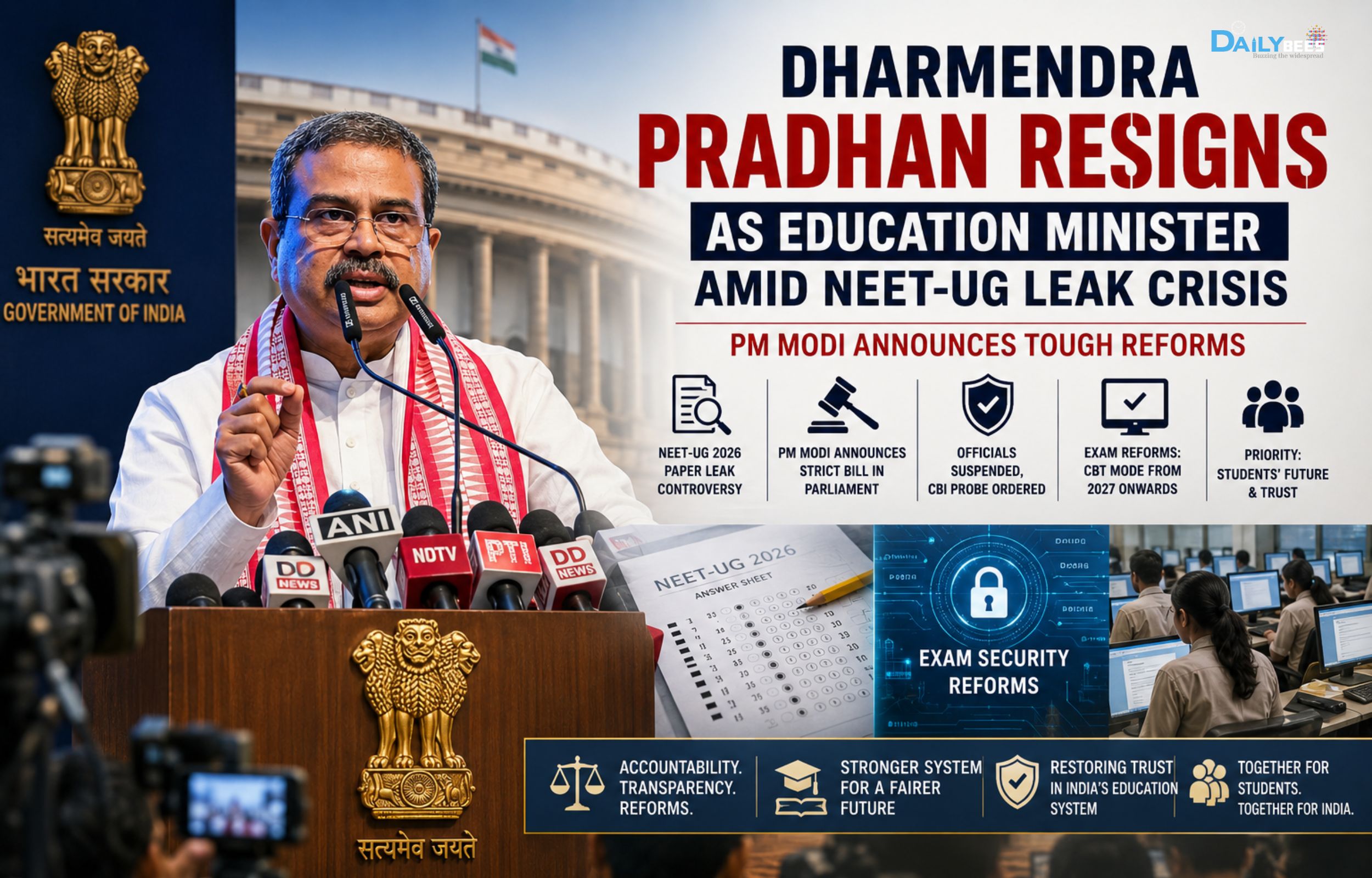
Union Education Minister Dharmendra Pradhan has resigned following nationwide protests over irregularities in the NEET-UG 2026 exam, marking one of the most significant political developments in India’s education sector.
The NEET-UG Controversy
- The exam held on May 3, 2026 was marred by allegations of paper leaks and malpractice.
- The government cancelled the test and re-conducted it on June 21, 2026.
- The CBI has been tasked with investigating the irregularities.
- Results were declared on July 16, 2026, but student anger continued.
Student Protests Across India
- Demonstrations erupted nationwide, led by student groups and the satirical Cockroach Janta Party (CJP).
- The turning point came on July 22, when police lathi-charged protesters in Delhi, sparking outrage.
- Opposition parties, including Congress, joined the protests, demanding Pradhan’s removal.
Dharmendra Pradhan’s Resignation
Pradhan submitted his resignation to Prime Minister Narendra Modi, stating he “never shied away from responsibility” and stepped down to protect students’ futures and prevent “anti-national forces” from exploiting the crisis.
A Full Circle Moment
Interestingly, this is not the first time Pradhan’s career has intersected with exam scandals. Back in 1997, as a student leader in Odisha, he led protests against paper leaks under the state government. Nearly three decades later, history repeated itself — but this time, he was on the other side of the table, resigning as Education Minister over similar allegations.
PM Modi’s Response and Reforms
Prime Minister Modi accepted the resignation and announced sweeping measures to restore trust in competitive exams:
New Bill Passed in Parliament:
- Strict imprisonment up to 10 years and heavy fines for anyone involved in paper leaks or organized exam malpractice.
- Designed as a strong deterrent against corruption in education.
Suspensions & Accountability:
- Multiple officials in the National Testing Agency (NTA) have been suspended.
- A broader overhaul of exam governance is underway.
Exam Reforms:
- NEET-UG and other major exams will shift to computer-based testing (CBT) from 2027.
- Enhanced digital monitoring and security protocols will be introduced.
Student-Centric Measures:
- Assurance that students will not face confusion or legal complications due to the crisis.
- Modi emphasized that the government’s priority is to protect the future of India’s youth.
Implications
For Students:
A stronger, more secure exam system is promised, with CBT reducing risks of leaks.
For Politics:
The resignation is seen as a victory for student power, highlighting youth influence in shaping policy.
For Governance:
Marks a turning point in India’s education system, with stricter laws and reforms to rebuild trust.
Conclusion
Dharmendra Pradhan’s resignation amid the NEET-UG leak crisis, coupled with PM Modi’s tough new bill and suspensions, signals a historic moment in India’s education sector. It is both a victory for students and a wake-up call for policymakers: exam integrity is non-negotiable, and the future of millions depends on it.