



























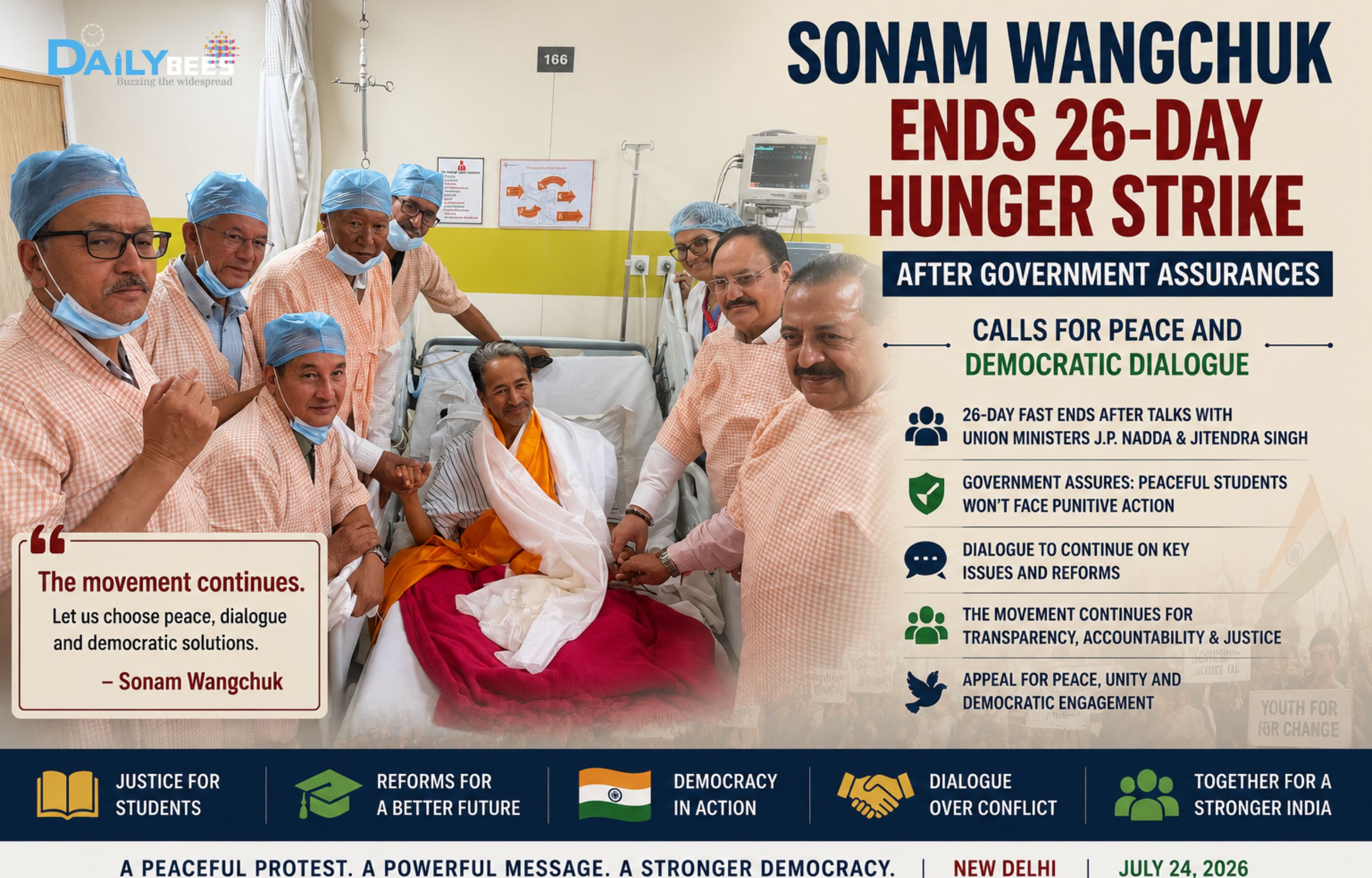
New Delhi, July 24, 2026: Environmentalist, education reform advocate, and social activist Sonam Wangchuk has officially ended his 26-day hunger strike, bringing one of India’s most closely watched protest movements to a temporary conclusion. The decision came after a series of high-level discussions with Union Ministers J.P. Nadda and Jitendra Singh, during which the Central Government reportedly assured protesters that students participating in peaceful demonstrations would not face punitive action and agreed to continue dialogue on the issues raised.
Sonam Wangchuk ended his 26-day hunger strike on Thursday, July 23, 2026 (late evening), after talks with Union Ministers J.P. Nadda and Jitendra Singh. The news was widely reported on Friday, July 24, 2026, which is why some publications mention July 24 in their headlines. Just before Wangchuk broke his fast, Prime Minister Narendra Modi released a late-night video message addressing the national crisis surrounding examination irregularities and the mass “Cockroach Janta Party” (CJP) youth protests.
Wangchuk announced that he was ending his fast primarily to prevent the possibility of violence and unrest across the country. While concluding the hunger strike, he clarified that the movement itself was far from over and urged citizens, especially students and young people, to continue advocating for transparency, accountability, and democratic reforms through peaceful means.
A Protest That Captured National Attention
The hunger strike began on June 28, when Wangchuk joined thousands of students protesting alleged irregularities and paper leaks in national entrance examinations. The demonstrations gained momentum after widespread outrage over examination security failures and growing concerns about the future of millions of aspirants.
Wangchuk’s participation transformed the movement into a nationwide campaign focused not only on examination reforms but also on broader issues of governance, accountability, and youth empowerment. His decision to undertake an indefinite fast drew support from students, teachers, civil society groups, environmental activists, and public figures from across India.
Throughout the 26-day fast, crowds gathered daily at Delhi’s Jantar Mantar, carrying placards demanding justice for students and greater transparency in the country’s examination system. Social media platforms witnessed millions of posts supporting the movement, with hashtags related to Wangchuk’s campaign trending consistently.
Government Opens Dialogue
The turning point came after several rounds of discussions between representatives of the protest movement and senior government officials.
According to official reports, Union Ministers J.P. Nadda and Jitendra Singh met Wangchuk shortly before he ended his fast. Sources indicated that the government assured protesters that peaceful student demonstrators would not face retaliation and expressed willingness to continue engaging on key concerns.
Following the meeting, Wangchuk announced that the assurances received were sufficient to suspend his fast while allowing the broader democratic movement to continue peacefully.
“The Movement Continues”
While ending the hunger strike, Wangchuk emphasized that ending a fast should not be mistaken for abandoning the cause.
He urged citizens to remain vigilant and continue participating in constitutional and peaceful forms of protest. According to Wangchuk, democracy becomes stronger when governments and citizens engage in dialogue rather than confrontation.
He also appealed to supporters to avoid violence under any circumstances, stressing that the objective has always been constructive reform rather than political conflict.
Health Concerns During the Fast
Medical professionals monitoring Wangchuk had repeatedly warned about the risks associated with his prolonged fast.
Reports suggested that he had lost a significant amount of body weight and had become physically weak after nearly four weeks without food. Supporters and doctors had urged him to end the fast before irreversible health complications developed.
Despite worsening health, Wangchuk continued until negotiations produced assurances that he considered meaningful enough to suspend the protest.
Nationwide Support
The protest witnessed unprecedented support from various sections of society.
Students from universities across India organized solidarity demonstrations. Teachers, education experts, retired bureaucrats, environmental activists, and several public personalities expressed concern about examination integrity and youth frustration.
Many supporters viewed Wangchuk’s hunger strike as symbolic of growing demands for transparent governance and stronger accountability in public institutions.
The movement also received international attention, with several global media organizations covering developments surrounding the protest and highlighting India’s ongoing debate over educational reforms.
Prime Minister Responds
Following the conclusion of the hunger strike, Prime Minister Narendra Modi publicly expressed concern for Wangchuk’s health and conveyed his best wishes for a speedy recovery.
The statement was viewed by many observers as an important acknowledgment of the significance the protest had acquired over the previous month.
Significance Beyond Education
Although the immediate trigger for the movement involved examination-related concerns, political observers believe Wangchuk’s protest evolved into something much broader.
For many young Indians, it became a platform for expressing concerns regarding governance, institutional accountability, employment opportunities, and public trust.
Wangchuk, who has previously led campaigns on environmental conservation, sustainable development, and constitutional protections for Ladakh, once again positioned himself as a prominent voice advocating peaceful democratic engagement.
What Happens Next?
With the hunger strike concluded, attention now shifts to whether the assurances provided by the government translate into concrete policy actions.
Student organizations have indicated that they will closely monitor future developments and continue engaging with authorities through peaceful demonstrations and dialogue.
Observers note that meaningful reforms will likely require sustained cooperation between policymakers, educational institutions, and civil society groups.
Meanwhile, Wangchuk has urged supporters not to view the end of his fast as the end of the movement. Instead, he described it as a new phase focused on democratic participation, continued vigilance, and constructive engagement with the government.
Looking Ahead
The conclusion of Sonam Wangchuk’s 26-day hunger strike marks a significant moment in India’s recent civic movements. It demonstrates how sustained, peaceful protests can draw national attention and encourage dialogue between citizens and the government.
Whether the commitments made during negotiations ultimately result in lasting reforms remains to be seen. However, the movement has already highlighted the growing expectations of India’s youth regarding transparency, fairness, and accountability in public institutions.
As Wangchuk begins his recovery, supporters hope that the conversations initiated during this historic protest will continue, ultimately leading to meaningful reforms that strengthen both India’s education system and its democratic institutions.