



























“What does a popular 1990s soda commercial have to do with one of the most brutal mountain wars in history?
In June 1999, standing on a freezing peak 17,000 feet above sea level, a young 24-year-old Indian captain radioed his commander with a simple four-word phrase that would catch the nation by storm: ‘Yeh Dil Maange More!’ It wasn’t a joke; it was a victory cry signifying that he had just reclaimed a crucial piece of India, and he was hungry to take back more.
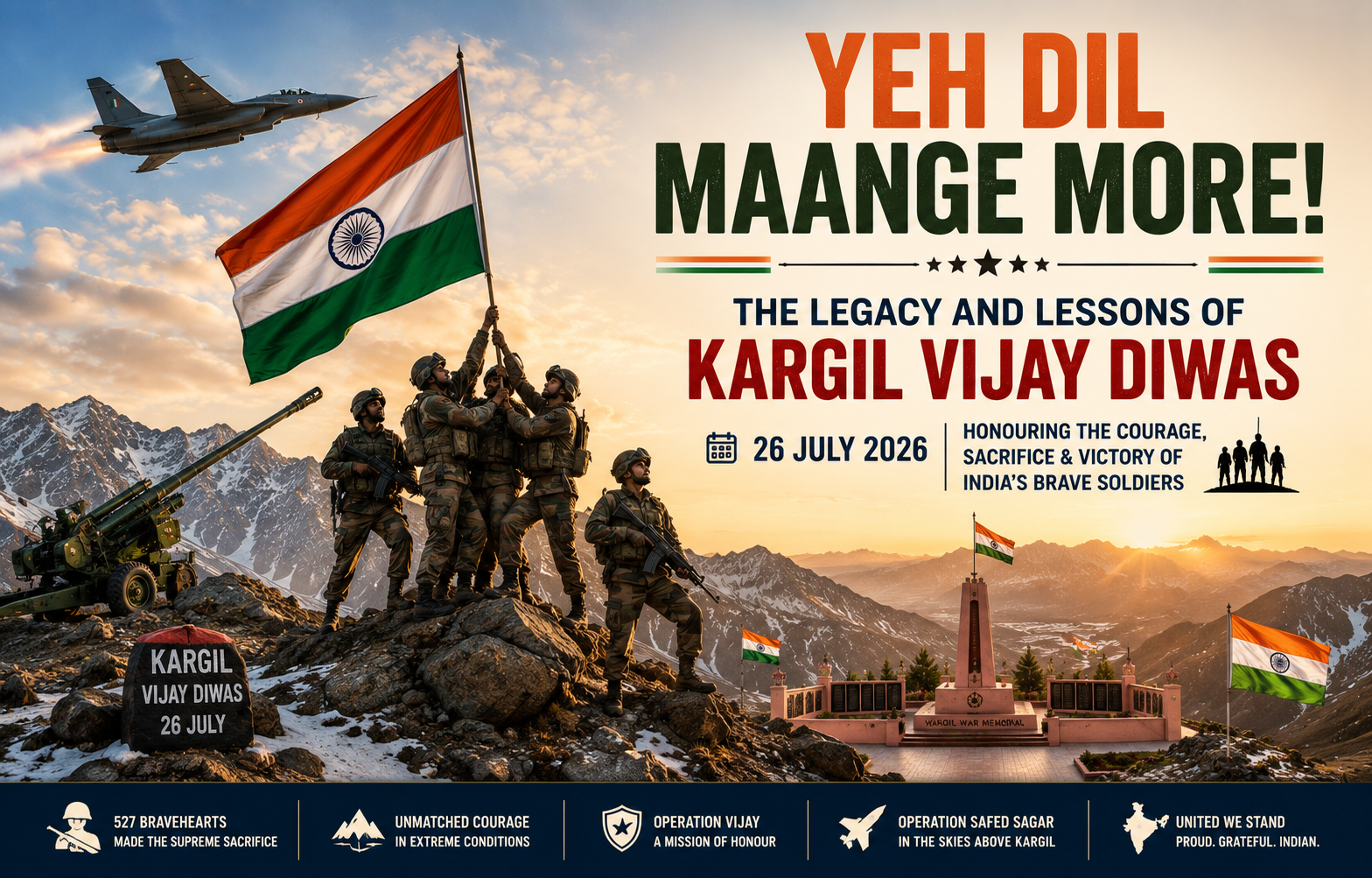
Every year on 26 July, the entire nation comes together to celebrate Kargil Vijay Diwas (Kargil Victory Day). It marks the historic day when India successfully won back its borders and pushed out intruders from the high peaks of Ladakh. But more than just a victory day, it is a heartfelt tribute to the 527 soldiers who made the ultimate sacrifice to keep us safe.
Let’s take a look at the incredible history, the unforgettable heroes, and the true spirit behind this day that makes every Indian heart swell with pride.
HISTORY AND ORIGIN OF KARGILVIJAY DIWAS
Every year on July 26th, a wave of profound pride and solemn remembrance sweeps across India. The tricolour waves a little higher, and the nation pauses to honour the heroes of the Kargil War. But have you ever wondered how this day of remembrance actually came to be? Who officially made the decision to carve July 26th permanently into India’s national calendar?
Here is the history behind who declared, founded, and first observed Kargil Vijay Diwas.
The Ultimate Declaration: The Vajpayee Government (1999)
Kargil Vijay Diwas was officially instituted and declared by the Government of India, led by the late Prime Minister Atal Bihari Vajpayee, in 1999.
The declaration was the direct culmination of a fierce, two-month-long high-altitude conflict. On July 26, 1999, the Indian Army officially announced the complete eviction of Pakistani infiltrators from the icy, jagged peaks of Kargil, Kargil district, and the Batalik sectors, marking the successful conclusion of Operation Vijay which was launched by the Indian Army to reclaim the stolen high-altitude peaks.
Recognizing that the sheer grit of the armed forces and the sacrifice of 527 soldiers deserved eternal remembrance, the Vajpayee administration, in close coordination with the military leadership, designated July 26th as a national day of remembrance.
Why is Kargil Vijay Diwas observed?
Kargil Vijay Diwas is observed for several profound military and national reasons:
- Honouring the Supreme Sacrifice: The primary purpose is to pay tribute to the 527 Indian soldiers who laid down their lives during the conflict. The day was founded on the battlefield, signed in the blood of heroes like Captain Vikram Batra (Param Vir Chakra), Lieutenant Manoj Kumar Pandey (Param Vir Chakra), and Major Rajesh Singh Adhikari (Maha Vir Chakra), alongside hundreds of others who displayed unmatched bravery
- Celebrating Extraordinary Valour: The war was fought under exceptionally hostile conditions—in freezing temperatures, and on jagged vertical peaks. The day celebrates the sheer grit, determination of the Indian Army and Air Force (Operation Safed Sagar) in overcoming these impossible odds.
- Reaffirming Territorial Integrity: It serves as a stark reminder of India’s unwavering resolve to protect its borders.
- A Pledge of National Vigilance: Beyond celebration, it is a day of reflection for the armed forces and the nation to emphasize defence preparedness, strategic vigilance, and the continuous need to safeguard national security.
Every year, the main commemorative events take place at the Kargil War Memorial in Dras, Ladakh, where the Prime Minister and military leadership lay wreaths to honour the fallen, alongside nationwide events to instil patriotic pride in the younger generation.
SPIRIT OF ‘YEH DIL MAANGE MORE’ : COURAGE WITHOUT LIMIT
When captain Vikram Batra,PVC ,uttered the words,” yeh dil maange more ”from the freezing bullet swept ridges ,he wasn’t just repeating a pepsi slogan but was redefining the limits of human endurance.
Kargil Vijay Diwas carries massive historical, emotional, and geopolitical weight.
- National Unity and Resilience: The war united a diverse nation overnight. Citizens from every corner of India stepped up to support the troops, cementing a deep, cultural bond between civilians and the armed forces.
- A Feat of Military History: Geopolitically, the conflict remains one of the most prominent examples of high-altitude warfare in modern history. The strategic and tactical operations executed by India under extreme physiological duress are still studied by military academies worldwide.
- A Continuous Legacy: Today, it reminds us of the constant vigilance required to maintain sovereignty, keeping the conversation around border security and veteran welfare highly relevant.
“Either I will come back after hoisting the Tricolor,or I will come back wrapped in it,but I will come back for sure.”
—Captain Vikram Batra
📱 KEEPING THE LEGACY OF KARGIL VIJAY DIWAS ALIVE IN THE DIGITAL AGE
Vijay Diwas is about actively honoring courage.You don’t need to be at the Dras War Memorial to pay your respects. In the age of smartphones,you can amplify the stories of our heroes with just a few clicks:
- Share a Story, Not Just a Graphic:
Instead of posting a generic “Happy Kargil Vijay Diwas” image on Instagram or WhatsApp, share a specific story. Post about Captain Vikram Batra’s wit, Gunjan Saxena’s flight hours, or Lieutenant Manoj Pandey’s diary entries. Let your circle know who we are celebrating.
- Adopt the #YehDilMaangeMore Challenge:
Dedicate your workout, your study session, or a personal goal on July 26th to the spirit of the Indian Army. Share your progress online with the hashtag to inspire others to give 100%to their daily battles.
- Write a Virtual Postcard:
Visit official Indian Army portals or veteran community pages to leave digital messages of gratitude for the troops currently guarding those identical freezing peaks today.
Some other meaningful ways in which individuals, families, and communities can participate:
- For Individuals:
Light a Diya (lamp) or candle in the evening to honor fallen soldiers. Spend time reading accounts of the war or watching documentaries like Operational Vijay to educate yourself.
- For Families:
Gather to share stories of India’s heroes. Teach younger generations about icons like Captain Vikram Batra and Lieutenant Manoj Kumar Pandey.
- For Schools:
Organize essay-writing competitions, poetry recitations, or screen short films about the Kargil War to instil a sense of gratitude and history.
- For Workplaces:
Observe a minute of silence before starting the day’s work, or set up a small fundraiser to support the welfare funds of Indian Army veterans and war widows.
BEHIND THE BATTLE LINES: TACTICAL INSIGHTS OF THE KARGIL WAR
Behind the victory at Kargil was a masterclass in military strategy. Winning back the peaks wasn’t just about raw courage—it required the Indian Armed Forces to rewrite the rules of war under impossible conditions.
Here is how the war was tactically won against all odds:
- The Highest Battlefield: The Kargil War was fought at altitudes scaling up to 18,000 feet, making it one of the most perilous high-altitude mountain warfare campaigns ever won.
- Bofors Turned the Tide: Despite prior political controversies surrounding the weapon, the Bofors FH77B field howitzers played a decisive role. Indian artillery fired over 250,000 shells during the conflict—the highest number of rounds fired since World War II.
- A Historic Air Campaign: The Indian Air Force launched Operation Safed Sagar acting alongside the ground forces. It marked the first time the IAF utilized laser-guided bombs to target enemy bunkers at such extreme heights.
FAQs
What is Kargil Vijay Diwas?
Kargil Vijay Diwas is a dedicated day observed in India to commemorate the victory of the Indian Armed Forces over infiltrating Pakistani troops in the Kargil sector during the 1999 war.
When is Kargil Vijay Diwas celebrated?
It is observed every year on 26 July, marking the exact day in 1999 when Operation Vijay was officially declared a success.
Why is Kargil Vijay Diwas important?
It is vital because it honors the sacrifices of 527 Indian soldiers who laid down their lives for the country, celebrates national sovereignty, and emphasizes the valor of the armed forces.
How can I celebrate Kargil Vijay Diwas?
You can celebrate by paying tribute online, participating in a minute of silence, supporting veteran organizations, lighting a lamp at home, or educating others about the history of the war.
THE LEGACY WE CARRY FORWARD
Captain Vikram Batra’s famous words, “Yeh Dil Maange More,” weren’t just a victory cry on a cold mountain peak. They were a statement about the human spirit. Today, that phrase reminds us that our soldiers always gave more—more bravery, more sacrifice, and more love for the country than anyone could ever ask for.
Kargil Vijay Diwas is a day of immense pride, but it is also a reminder. The peace we enjoy today was bought at a heavy price on those steep, freezing heights. The best way we can honor our heroes is by bringing that same spirit into our everyday lives—by constantly striving to do more and be better for our nation.
OVER TO YOU
Our flag does not fly because the wind moves it, it flies with the last breath of each soldier who died protecting it.”
Every story of Kargil is a lesson in courage. Which soldier’s story or tactical breakthrough from this war inspires you the most?
JOIN THE TRIBUTE:
How are you honoring our soldiers today? Share this article to spread awareness, and drop a message of gratitude in the comments below using the hashtag #KargilVijayDiwas and let’s keep the memory of our heroes alive! Jai Hind.